New York Sea Grant - Marine Heritage Trail
The History of Hard Clams In New York
Jump to...

1800s
Maritime Commerce Ingenuity
Clams were more affordable than oysters, which inspired Italian and Chinese immigrants to establish seafood businesses specializing in this shellfish.

1889
Clams Come to Main Street
The Clam, a ten-seat restaurant on Fulton Street, was reported on by the Evening Sun. This establishment was believed to be one of the first single-serving restaurants specializing in clams and clam products.

1865
Doxsee Clam Company Is Founded
In 1865, the first Long Island clam processing plant in Islip was opened by James H. Doxsee. The company sold clams to local residents and local markets, and advertised clams, clam juice, and clam powder.

1900
Signs of Downturn Begin
Wild clam shortages in the Great South Bay forced Doxsee company to close the canning operation.

1947
Hard Clam Landings Recover
Hard clams were harvested in record numbers in New York, totaling over 10 million pounds of clam meat.

1970
Hard Clams Increase in Value
Beginning in 1970, the dockside value of hard clams surpassed the value of other shellfish species.

1980s
Brown Tide Damages Long Island's Hard Clam Supply
The Great South Bay was impacted repeatedly by brown tide throughout the mid-80s. Brown tide is a deadly algae bloom that affects shellfish and fish by depriving them of oxygen, or by releasing toxins.
1996
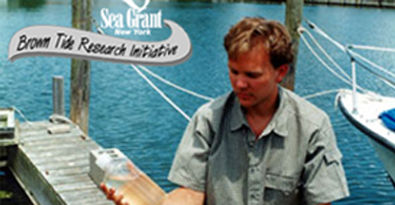
New York Sea Grant Launches a Brown Tide Research Initiative
Due to the damage caused by brown tide beginning in the 1980s, NYSG launched a research and education initiative to understand the causes of brown tide and spread awareness to the general public.


2008
Hard Clam Population Shows Improvement
250 million baby clams were located where in the land that Bluepoint Oyster Company donated, and clam populations experienced a 40-fold increase from their baseline numbers.

2004
A New Lease on Life
The Nature Conservancy purchased land in the Great South Bay from Bluepoint Oyster Company. From 2004 to 2010, 13,000 acres were used to plant four million adult clams relocated from Connecticut and other areas within Long Island.

2012
Hard Clam Production Recovery
Hard clam production increased in New York by more than 70%. After consistent local and state efforts to improve water quality in the Long Island Sound, aquaculture production increased. Reopening of wild shellfish beds contributed to the rise in hard clam production to increase. There is still work to be done to achieve historical production levels.

Present-Day
Hard Clams Today
Most clams are wild harvested and New York continues to encourage hard clam aquaculture.
Picture Citations:
1. The hard clam Mercenaria mercenaria. ©Margaret Pizer/VASG" by Virginia Sea Grant is marked with CC BY-ND 2.0.
2. slip station. 19.3.60" by Roger Joanes is marked with CC BY-NC-ND 2.0.
3. "Fulton Street" by pingnews.com is marked with CC BY-SA 2.0
4. The Bare Bay" by mrpbps is marked with CC BY 2.0
5. hard clams" by Florida Sea Grant is marked with CC BY-NC-ND 2.0
6. Artwork inspired by historical photographs available at the Long Island Maritime Museum Library
7. Atkins Farms Country Market, Amherst MA" by Rusty Clark ~ 100K Photos is marked with CC BY 2.0
8. Brachidontes domingensis (Domingo mussels) encrusting intertidal-zone aragonitic limestone (San Salvador Island, Bahamas) 1" by James St. John is marked with CC BY 2.0
9. Shellfish beds" by nordique is marked with CC BY 2.0
10. Ellsworth: Jasper's Restaurant" by wallyg is marked with CC BY-NC-ND 2.0
11. Hard Clam (Mercenaria mercenaria)" by acryptozoo is marked with CC BY 2.0
12. mercado central." by matt.hintsa is marked with CC BY-NC-ND 2.0
13. Rock Chair B" by Bob Rheault is marked with CC BY 2.0
14. Mussels and clams , Hot Water Beach, Coromandel, New Zealand" by Jim 03 is marked with CC BY-NC-SA 2.0
15. Great South Bay, New York" by eutrophication&hypoxia is marked with CC BY 2.0
16. Sea shells 2" by árticotropical is marked with CC BY 2.0
17. Pyritized brachiopods (Silica Formation, Middle Devonian; quarry in Sylvania area, Lucas County, northwestern Ohio, USA)" by James St. John is marked with CC BY 2.0
18. "Brown tide" Photo by Caitlin Finnerty/Chesapeake Bay Program